


“Remain Profoundly Human”Reflections on Pope Leo XIV’s First Encyclical. Claire Henning, D.Min

Updated: Aug 30
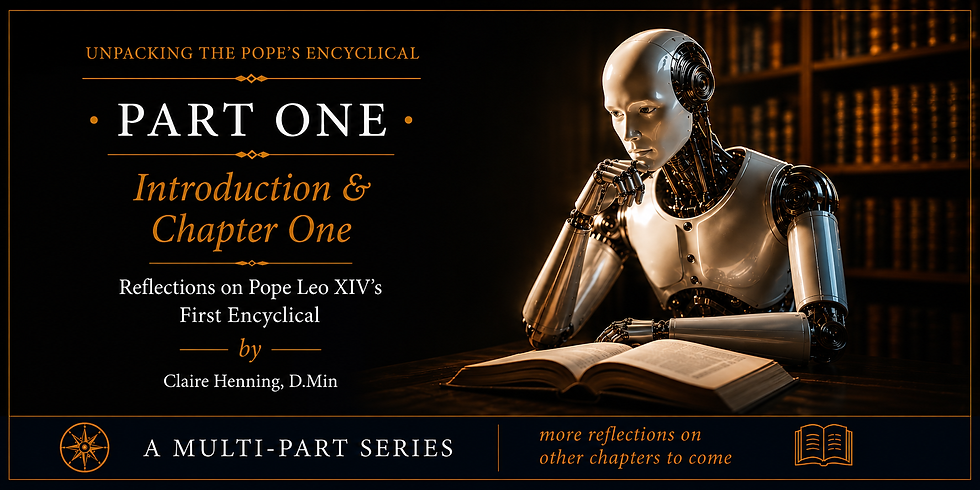
Introduction and Chapter One
There is a reason Pope Leo XIV’s first encyclical, Magnifica Humanitas, is receiving so much attention. While the headlines focus on artificial intelligence, beneath the discussion of technology is a powerful reflection on human dignity, relationships, and what it means to remain profoundly human in our modern age. The encyclical is surprisingly readable, albeit long and dense. I am reading it slowly. Here are a few insights I have taken from the Introduction and Chapter One.
The Holy Father begins with a powerful image. Humanity, he says, stands between two choices. We can build another “Tower of Babel,” or we can rebuild Jerusalem as it was rebuilt under Nehemiah (Neh 1-6). Babel (Gen 11:1-9) represents a world built on pride and uniformity, where power matters more than people. Jerusalem, however, is rebuilt slowly through prayer, cooperation, listening, and shared responsibility. Families, workers, priests, and ordinary citizens each rebuild their own small part of the wall. Pope Leo clearly believes this second image is the path we are called to follow today.
Pope Leo does not approach technology with fear. He recognizes the good that science and innovation can accomplish. Technology can heal, educate, connect people, and improve lives. At the same time, he reminds us that technology is never truly neutral. It reflects the values of the people who create it, finance it, and control it (.9).
At one point, the Pope writes, “It has become increasingly evident how rapidly and profoundly digitalization, artificial intelligence, and robotics are transforming our world” (.4). He then quotes Pope Francis: “Never has humanity had such power over itself” (Laudato Si’, 104). Those words capture both the promise and the danger of this moment in history.
Pope Leo speaks directly to the uncertainty many people feel today when he writes, “We are living through a rapid phase of transition, a ‘change of era.’ He then asks the questions at the heart of the encyclical: “Where are we going? Toward what goal do we wish to orient ourselves? What direction should we choose as a people and as a human community?” (.6)
The deeper concern of the encyclical is not whether machines are becoming smarter. The real concern is whether human beings are forgetting who we are.
Throughout the introduction, Pope Leo returns again and again to the dignity of the human person. Human life cannot be reduced to data, productivity, or efficiency. Every person carries a God-given worth that no algorithm can measure and no machine can replace. In a culture obsessed with speed and performance, the Pope warns that “we place our hope in unlimited ‘upgrades,’ in forms of progress that exacerbate inequalities, and in immediate solutions incapable of healing people’s wounds. As a result, while some pursue the illusion of unlimited self-assertion, many are deprived of basic necessities” (.12).
It is difficult not to see our own world reflected in those words. We are surrounded by promises that technology will solve every problem, yet loneliness, poverty, division, and anxiety continue to grow.
Pope Leo strongly affirms something that may surprise some readers: the Church and the political community “must operate with full autonomy” (.21). In other words, the Church is not trying to run governments or replace civil institutions. Rather, the Church serves society by defending human dignity, encouraging justice, and reminding the world that economics, politics, and technology must always serve people, not the other way around.
Before getting into the nuts and bolts of his teaching on artificial intelligence, Pope Leo takes this introductory time to trace the development of the Church’s social teachings. He writes, “Although the expression ‘Social Doctrine of the Church’ was coined by Pius XII in 1950, its content began to take shape as an organic corpus of social teaching with Leo XIII” (.29). He notes that from Leo XIII to Francis, popes have responded to the major issues of their own times. Here is a quick overview of the key developments that Pope Leo points to:
• Pope Leo XIII addressed the struggles caused by the Industrial Revolution, defending the dignity of workers and the rights of labor while warning against both unchecked capitalism and socialism.
• Pope Pius XI expanded this teaching during a time of economic upheaval and rising totalitarianism, emphasizing social justice and the principle of subsidiarity.
• Pope Pius XII helped articulate the idea of a coherent body of Catholic social doctrine during the turmoil surrounding World War II and its aftermath.
• Pope John XXIII focused on human rights, peace among nations, and the responsibilities that accompany freedom in an increasingly interconnected world.
• Pope Paul VI highlighted global inequality and the moral dimensions of economic development, calling attention to the needs of poorer nations.
• Pope John Paul II reflected on the dignity of human work, the dangers of consumerism, and the spiritual dimensions of freedom after the collapse of communism.
• Pope Benedict XVI emphasized that authentic human development must be rooted in truth and charity, especially amid globalization and technological growth.
• Pope Francis broadened Catholic social teaching by connecting care for creation, economic justice, and concern for the poor within the idea of “integral ecology.”
Pope Leo suggests that artificial intelligence now presents the Church with another major historical moment requiring moral reflection, just as earlier popes responded to the defining social and economic challenges of their own eras.
Each generation faced new challenges, but the core message remained the same. Human beings are never disposable. The poor must not be forgotten. Work has dignity. Peace matters. Communities matter. And faith must shape the way we live together.
Perhaps the most powerful line in these opening pages comes near the end of the introduction when Pope Leo says that in the age of artificial intelligence, “ours is the pressing duty to remain profoundly human” (.15).
That may well be the true heart of this entire document. As I continue reading through the encyclical, I look forward to sharing more reflections on Pope Leo’s vision for faith, humanity, and the challenges of our modern world.
If you found this read enriching, you may also enjoy: Reflection on Pope Leo XIV's First Encyclical, The Measure of True Progress, and Three Pillars of Human Life.


♥️
Always love your explanations. Thank you for sharing.
Claire, Thank you for this summary. It's very clear and helpful.
Thank you, Claire for a clear and lovely explanation...
Love this read